

AI search is reshaping how customers find your business—but most businesses get stuck between knowing what to do and actually doing it. Discover the implementation framework that closes the gap, with real examples and actionable steps.
I spend a lot of time demonstrating AI search tools to businesses. I'll pull up ChatGPT, ask it to plan a weekend getaway or recommend a service, and show them how their customers are already using these tools to make decisions.
The demos always land. People get it. They see how AI search is fundamentally different from Google. They understand the shift is happening.
Then comes the question I hear at every single session—especially from small and medium businesses without endless marketing budgets:
"How do I actually make my business appear in these AI search results?"
It's not a theory question. It's not about whether AI search matters. It's about the practical gap between understanding the problem and knowing what to do about it.
Let me show you what that actually looks like.
The Real Barrier Isn't Knowledge
Most businesses I work with already understand that AI search is changing discovery. They've read the articles. They know it matters.
The barrier is the space between knowing and doing.
You get the AI recommendations, and then... what? Do you rewrite your entire website? Do you hire someone? Do you even know if it worked?
So you do nothing. And another month passes.
Here's what I've learned from implementing AI strategies across multiple businesses: small, completed actions beat large, perfect plans.
Four hours over five days changed how AI search finds and recommends a business. Not a complete overhaul. Not hiring an agency. Just focused work on one specific improvement.
The Homework Assignment Everyone Gets (And Nobody Completes)
Tomorrow, I'm presenting to the Logan Tourism Body about AI and marketing. At the end, I'm giving them homework—a simple prompt to paste into ChatGPT:
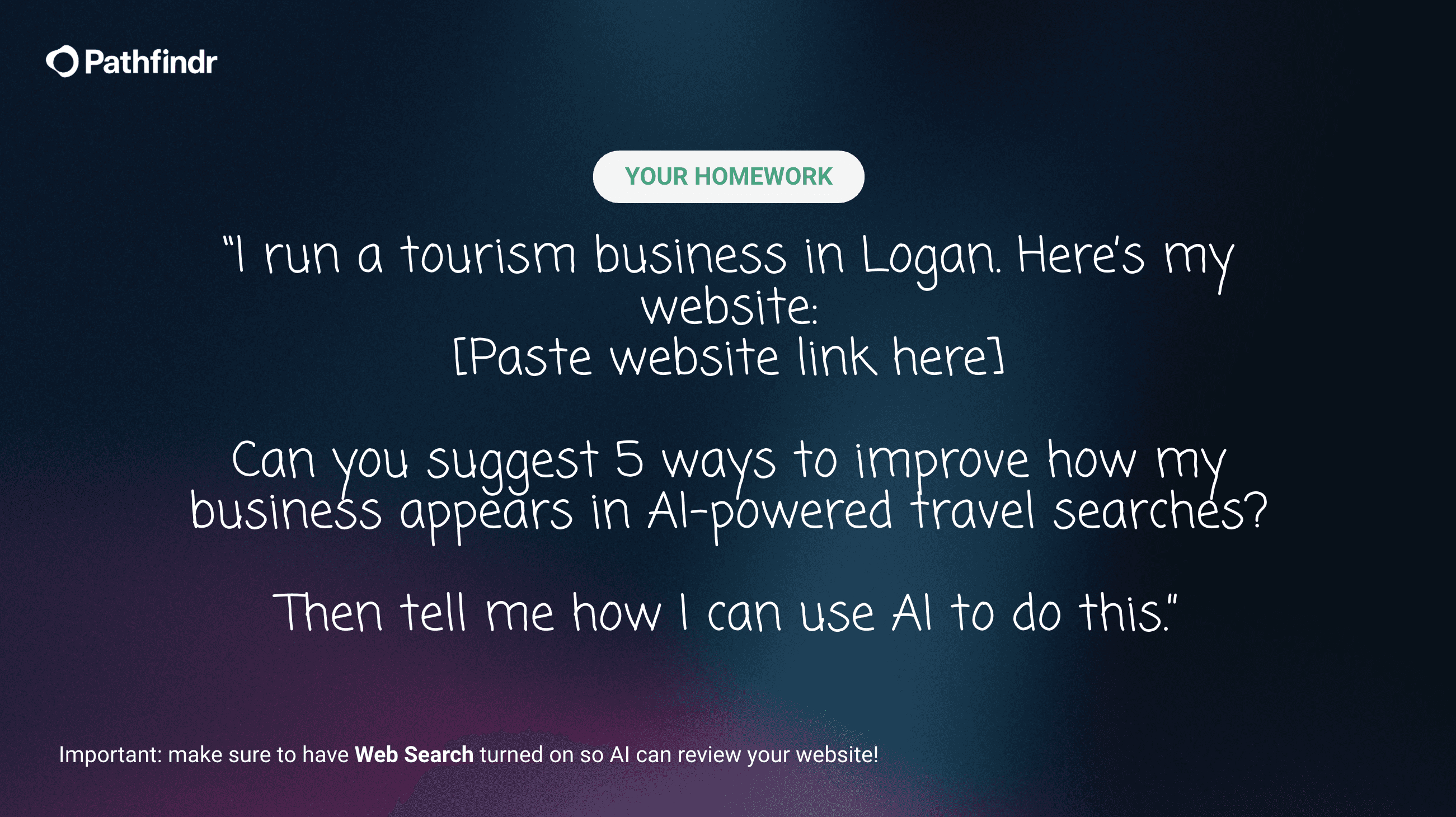
Here's what happens next for most businesses:
They run the prompt ✅
ChatGPT gives them 5 solid recommendations ✅
They think "Great, I'll do this!" ✅
They close the tab ❌
Nothing changes ❌
The problem isn't the recommendations. The problem is that "5 ways to improve" doesn't automatically become "5 things I did."
What Implementation Actually Looks Like
Let me walk you through a real example. Not theory—actual steps, actual time invested, actual results.
I took one common AI search recommendation and implemented it over five days. Total time investment? About 4 hours. Here's the day-by-day breakdown.
Side Note: Why Small Businesses Actually Have the Advantage
AI search is like a personal travel companion, not a guidebook listing popular places (read more about how AI Search works).
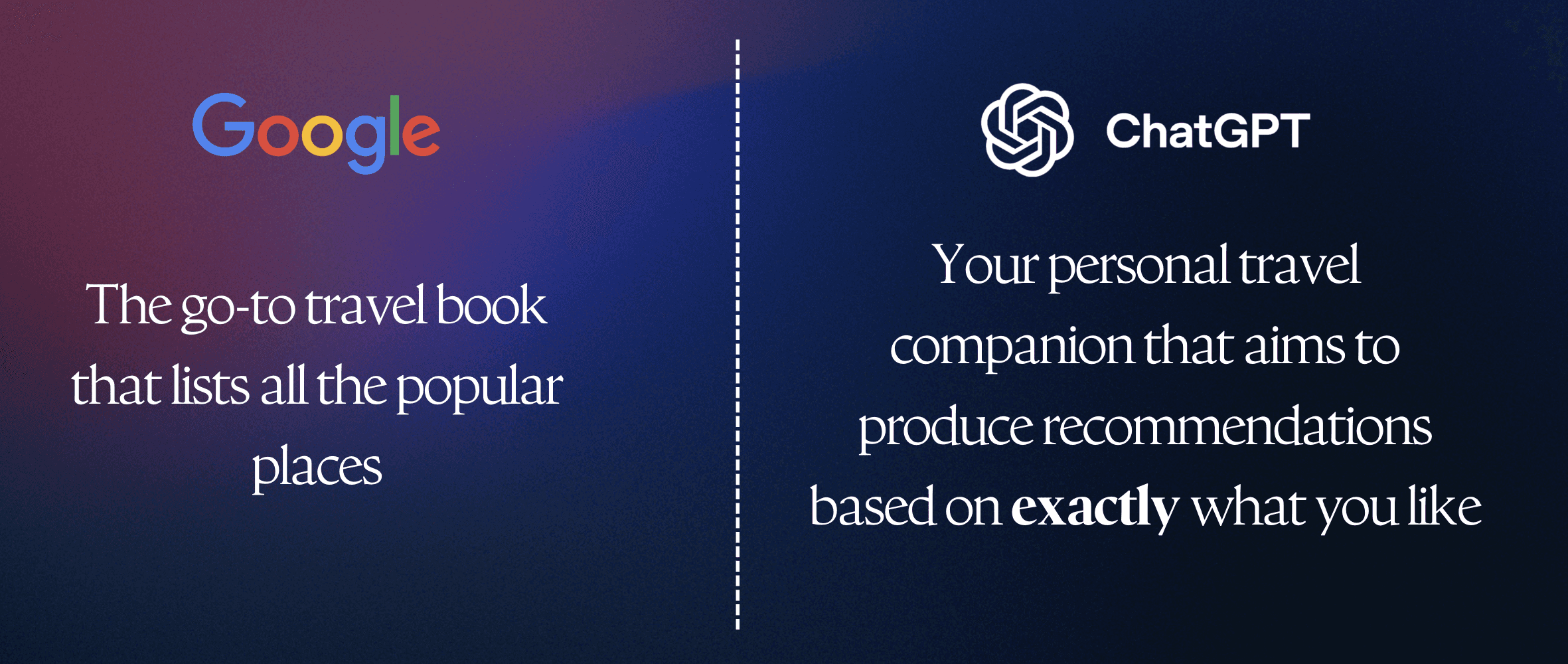
Traditional SEO favored businesses with big budgets—those who could afford SEO agencies, paid ads, and content teams. AI search levels the playing field because it prioritizes specific, descriptive, relevant content over marketing spend.
A small eco-lodge with detailed, authentic descriptions of their bushwalking tours can outrank a large resort with generic "luxury experience" copy. AI doesn't care about your marketing budget. It cares about whether it can confidently recommend you to the right person.
Implementation beats budget.
Monday Morning: Test Your Current State
Time invested: 15 minutes
First, I needed to know what AI search actually finds about a tourism business right now.
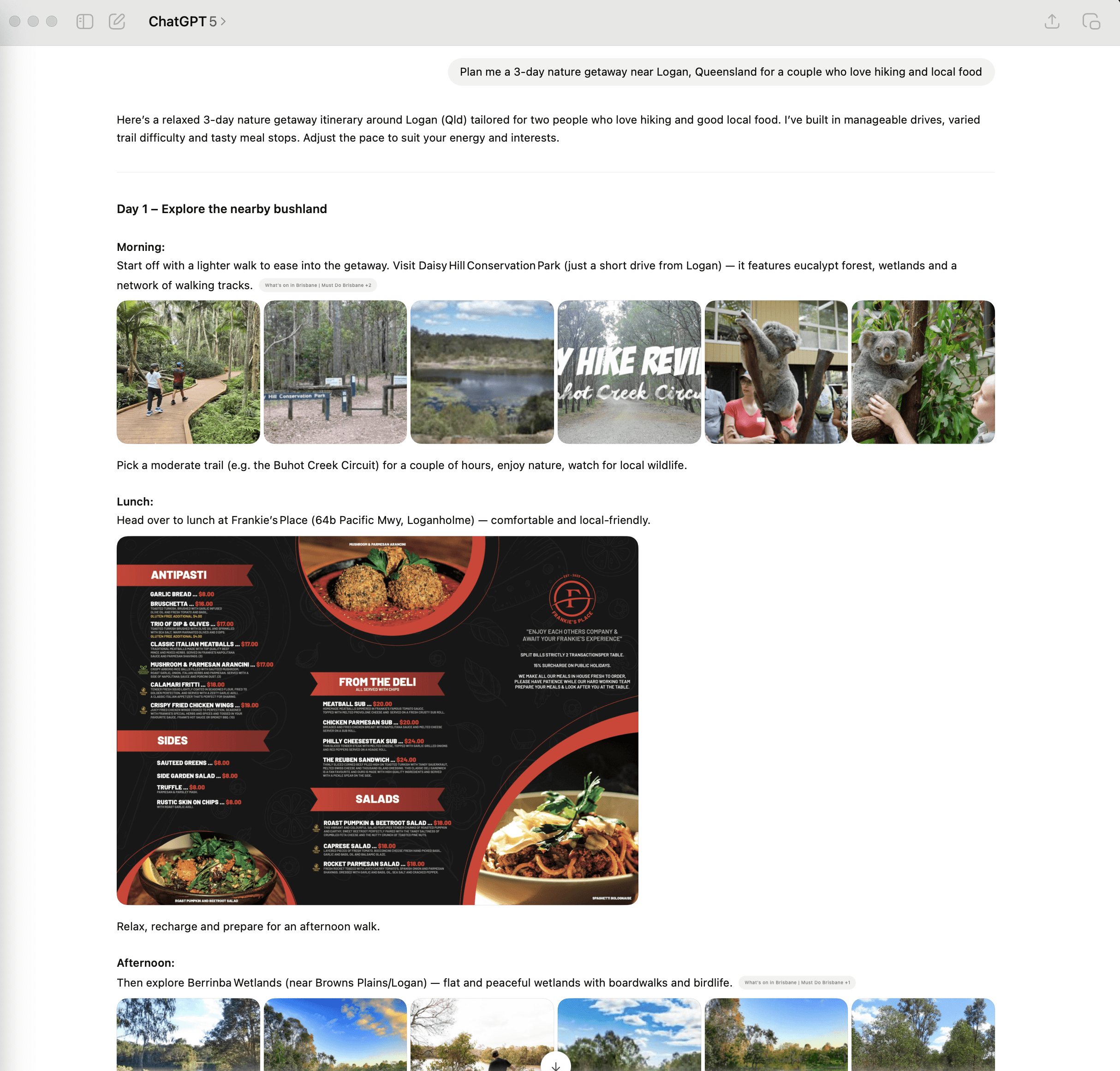
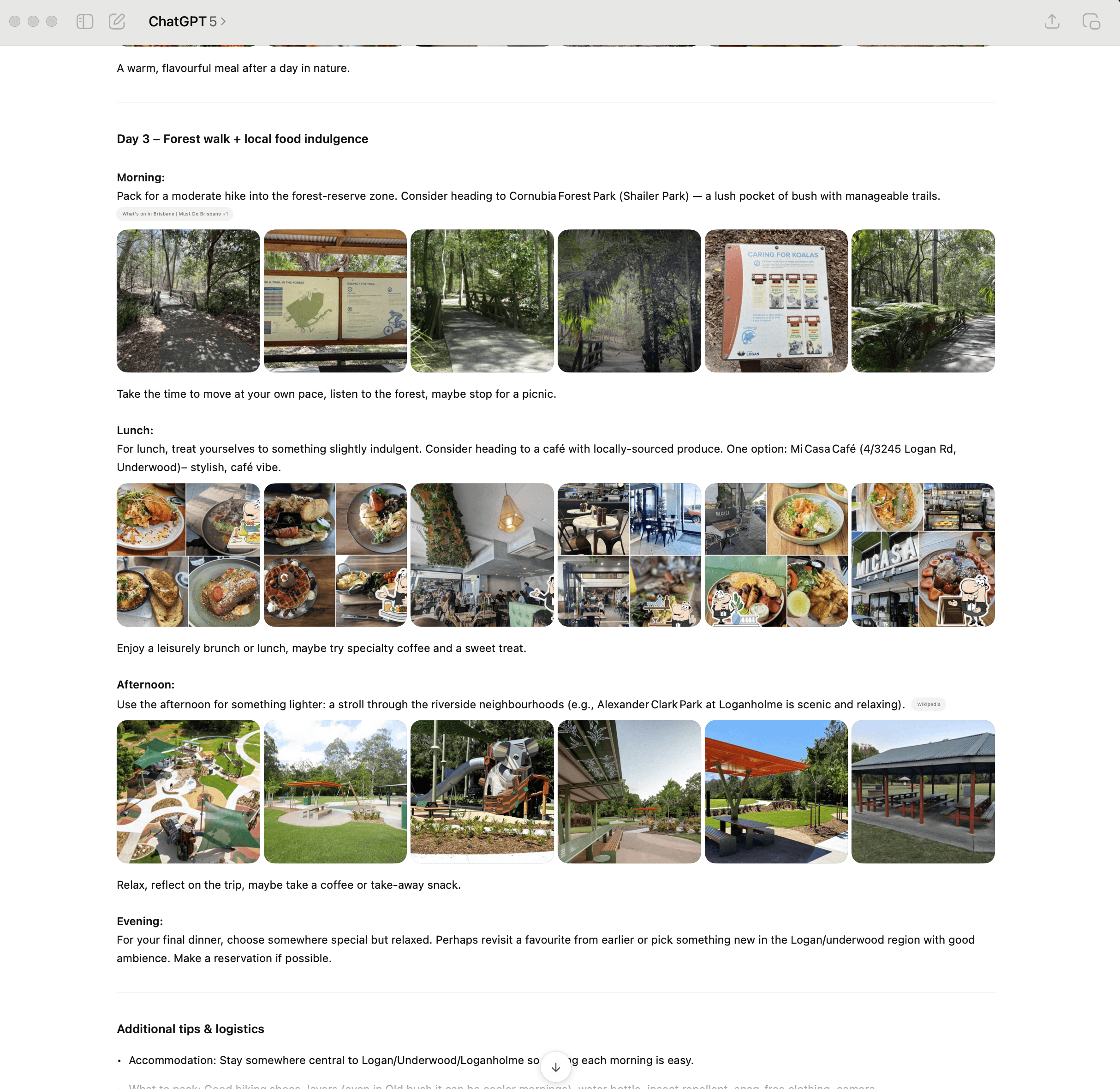
What AI recommends when travellers search for experiences near Logan
Notice which businesses appear (and which don't).
The pattern is clear: AI recommended businesses with descriptive, specific content about their experiences. Generic descriptions like "beautiful location" or "great atmosphere"? Those businesses didn't appear.
When I asked ChatGPT how it decided to pick specific restaurants, it said it had prioritised based on:
Proximity to each day’s hiking locations to avoid long detours.
Locally-owned or regionally sourced food rather than chains.
Atmosphere that matches the tone of the day — laid-back for lunches, a bit more special for dinners.
Menu quality with fresh ingredients and strong community reputation.
Notice how it's making recommendations based on my personal preferences (hiking and local foods)? This is where AI is better than any travel guide out there - it's job is to find the best place for you.
Monday Afternoon: Pick ONE Thing
Time invested: 5 minutes (to decide which recommendation to tackle first)
Let's pretend I own a small business - it's an eco lodge that offers accommodation to couples and families. After I completed my homework, it's given me some recommendations for my website.
At random, I decide to work on this suggestion:
Be more descriptive—help AI understand what you actually offer.
Tuesday: Audit Your Current Content
Time invested: 30 minutes (including reading through current website content)
I used AI to audit existing website copy. Here's the prompt I used:
"I run a nature-based eco lodge business. Here's the text from my homepage: [paste content]. Rate how well this content would help AI search understand and recommend my business. What specific details are missing?"
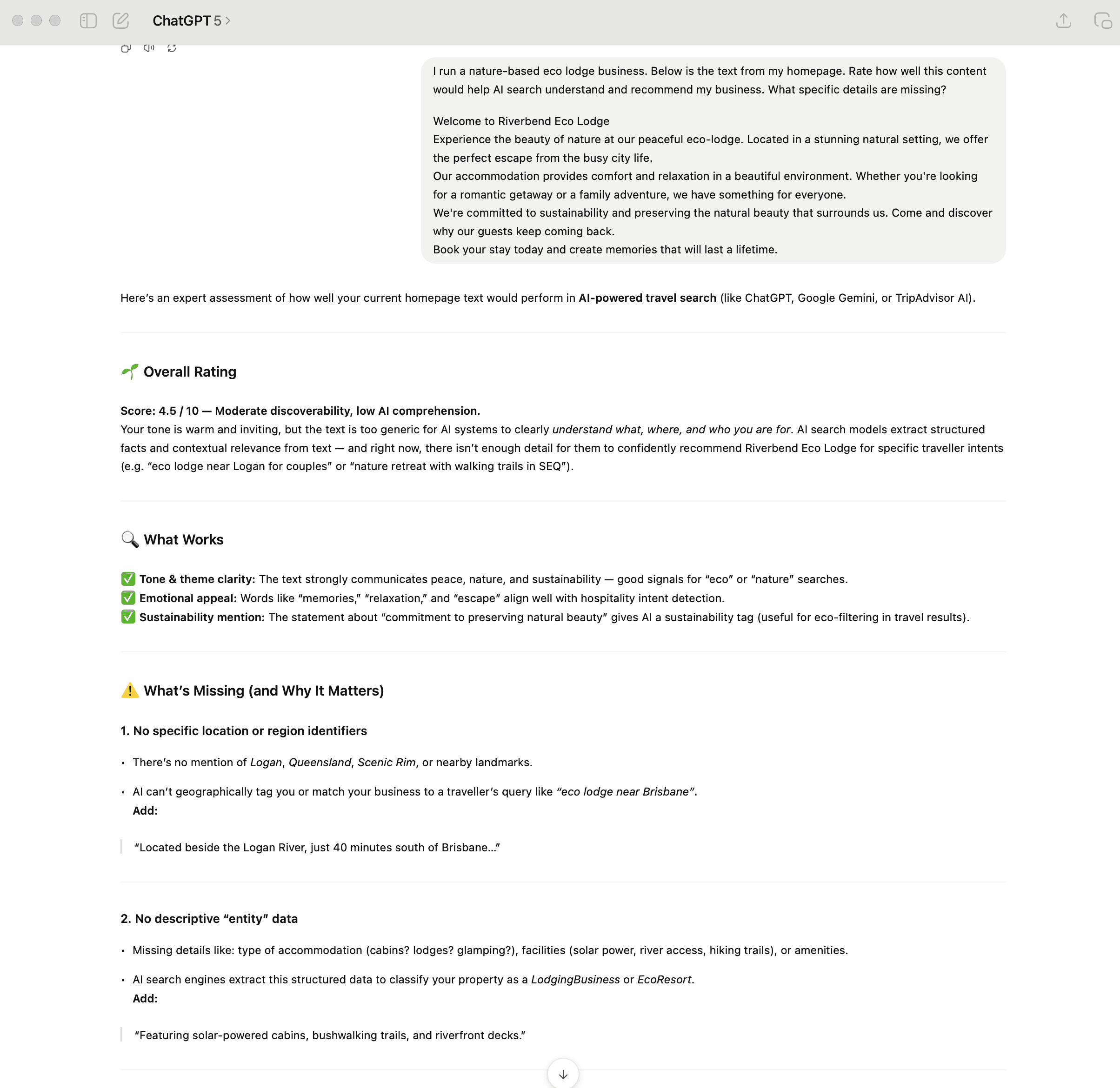
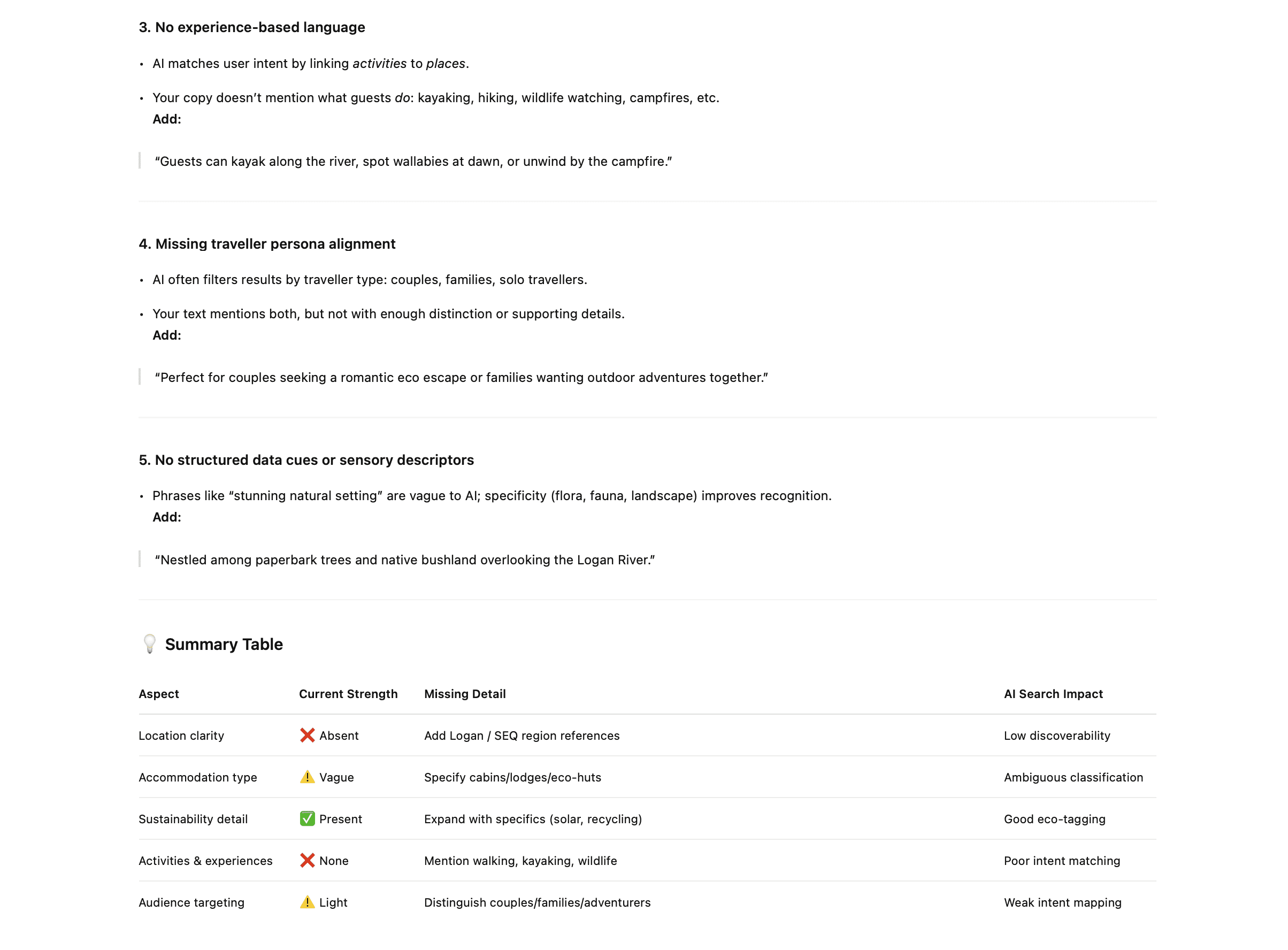
AI's brutally honest assessment of current website content
The gaps were obvious:
No specific activities mentioned
No distance/time from Brisbane
No details about the experience itself
No mention of what makes it unique
Wednesday: Rewrite With AI Assistance
Time invested: 1 hour (including multiple revision rounds)
I rewrote one key section—the homepage intro — using this prompt:
"Rewrite my homepage introduction to include: specific activities (bushwalking, birdwatching), exact distance from Brisbane (45 minutes) and Logan Centre (10 mins), unique features (riverside cabins, guided night walks), and target audience (couples and families). Keep the tone warm and welcoming.
Make sure it is written in a way that is friendly for SEO and AI Search discoverability."
This is what ChatGPT comes back for me:
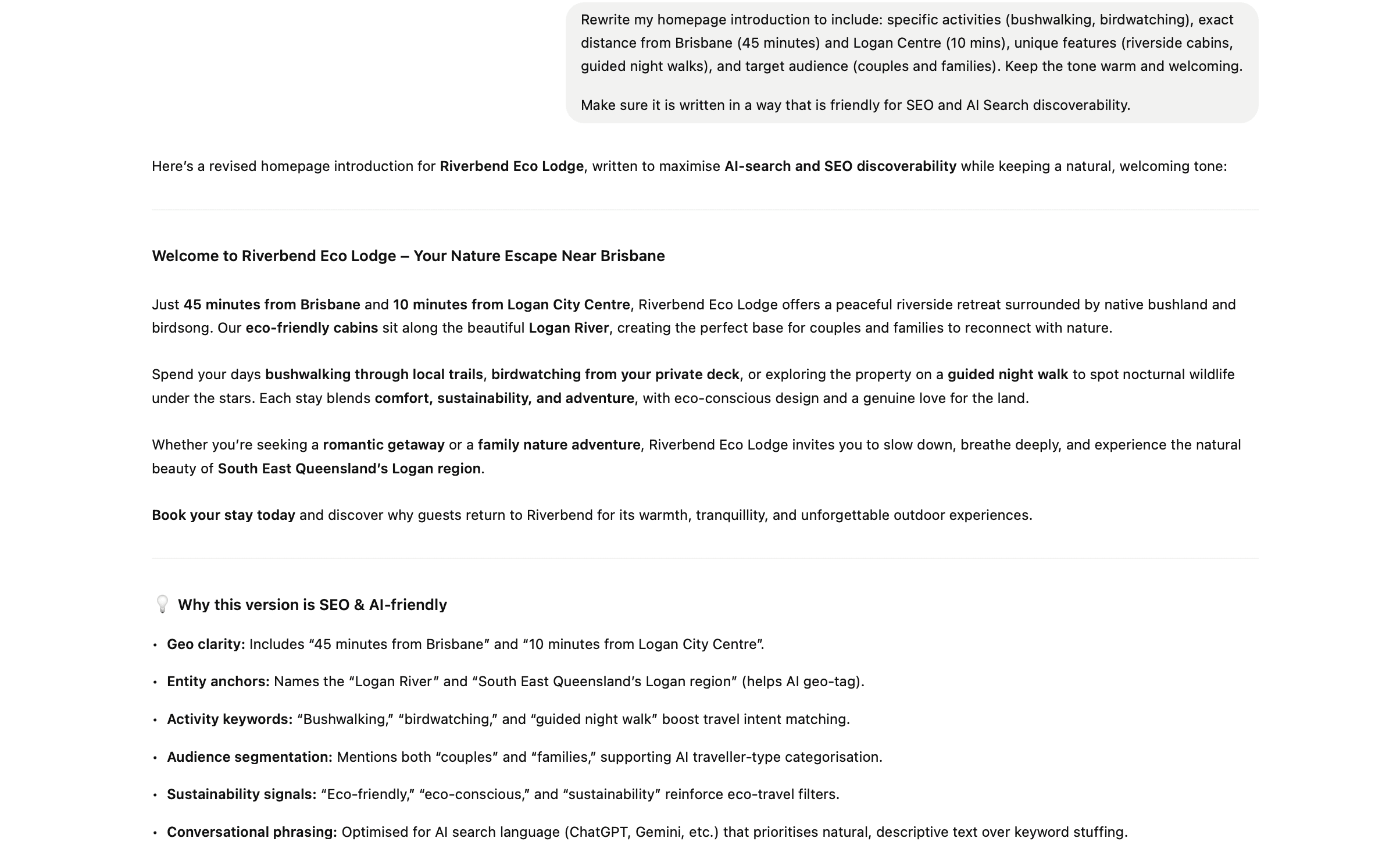
My updated homepage text, courtesy of ChatGPT
The difference from my original homepage text? Specific, searchable details that help AI understand exactly what you offer and who it's for.
Hint: you don't have to take the first suggestion. Give AI feedback on what you like and don't like until it feels right for you.
Thursday: Update Your Website
Time invested: 30 minutes (including uploading to website or emailing developer)
Time to make it real and update my homepage with the new content. The key is making sure your live website reflects the improvements. AI search tools crawl actual websites—if the changes only live in a Google Doc, they won't help you appear in search results.
If you manage your own website
If you manage your own website (Wix, Squarespace, WordPress), this is straightforward—paste the new copy and hit publish.
Pro tip for DIY website owners: While you're updating text, consider refreshing your visuals too. Tools like Google's Gemini Veo3 or Nanobanana can help you create or enhance images that match your new, more descriptive content. If your copy now mentions "riverside cabins at sunset," make sure your images actually show that.
If someone else manages your website
If you have a web developer, send them the updated text with context: "I'm updating my homepage to improve AI search visibility. Please replace [current section] with this new content."
Friday: Relax and Celebrate
Time invested: 10 minutes
You've done the work. Now it's time to let AI search tools do theirs.
The changes need time to be indexed and recognised by AI systems. So Friday? Take the win. You've closed the implementation gap that stops most businesses.
Document what you did:
What changed: Homepage description
Time invested: ~4 hours total across the week
Next action: Apply same approach to another page on your website next week
Total time for complete implementation: 4 hours across 5 days
The Implementation Framework That Actually Works
Here's the pattern that works across any AI search recommendation:
1. Test Current State Run the tourist/customer search yourself. What does AI find about you RIGHT NOW? Use the demo approach: ask ChatGPT to plan a trip, recommend a service, or solve a problem your business addresses.
2. Pick ONE Thing Not all 5 recommendations. Just one. The one you can complete this week.
3. Use AI to Fix It The meta approach: use AI to implement AI strategies. Let it audit your content, suggest improvements, and help you rewrite. You're not starting from scratch.
4. Move to Next Only after completing one. This isn't a sprint—it's sustainable improvement.